
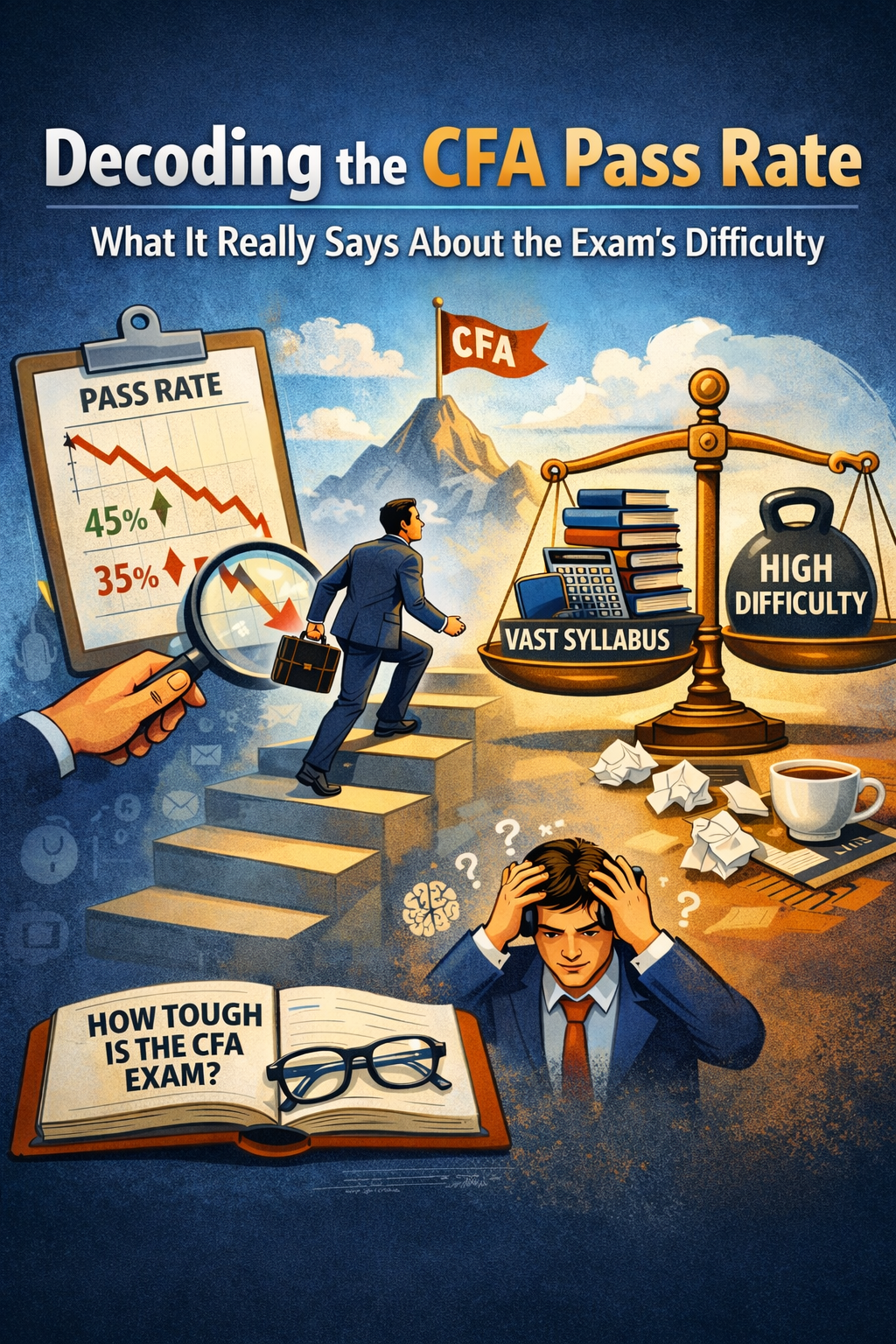
Decoding the CFA Pass Rate: What It Really Says About the Exam’s Difficulty
If you’re planning to pursue the CFA program, you’ve probably Googled this at least once:
“CFA pass rate”
And what you saw may have scared you.
Numbers like 35%, 40%, or 45% often create the impression that the CFA exam is impossibly difficult. But as a career coach who works closely with finance students and professionals, I can tell you this:
CFA pass rates don’t tell the full story.
Let’s decode what the CFA pass rate really means, why it is low, and what it actually says about the exam’s difficulty — especially for students looking for CFA classes in Jaipur or CFA classes online.
What Is the CFA Pass Rate?
The CFA pass rate refers to the percentage of candidates who successfully clear each level of the CFA exam in a particular exam window. The CFA exams are conducted by the CFA Institute, a globally recognised body for investment and finance professionals.
Historically:
– CFA Level I pass rates usually range between 35% to 45%
– CFA Level II pass rates are slightly higher, around 40% to 50%
– CFA Level III pass rates are typically the highest, often between 45% to 55%
At first glance, these numbers look intimidating. But numbers without context can be misleading.
Why Are CFA Pass Rates Low? (The Real Reasons)
Low CFA pass rates are not just about exam difficulty. They are about who attempts the exam and how they prepare.
1. CFA Tests Depth, Not Memory
Unlike many exams, CFA does not reward rote learning. It tests whether you can apply concepts to unfamiliar situations. This shift alone eliminates a large percentage of unprepared candidates.
2. The Candidate Pool Is Extremely Diverse
CFA candidates include:
– Fresh graduates
– Working professionals
– Career switchers
– Candidates from non-finance backgrounds
Many candidates underestimate the syllabus and overestimate their preparation, which directly affects pass rates.
3. Time Commitment Is Non-Negotiable
The CFA Institute recommends 300+ study hours per level. Candidates who treat CFA like a college exam often struggle.
4. Ethics Is a Silent Filter
Ethics is tested across all levels and often becomes the deciding factor near the minimum passing score.
Does Low Pass Rate Mean CFA Is Too Difficult?
Not necessarily.
A low pass rate does NOT mean:
– You need to be a topper
– You need a finance background from a premium college
– You need extraordinary intelligence
It DOES mean:
– You need consistency
– You need structured preparation
– You need conceptual clarity
In reality, CFA is difficult because it demands discipline, not brilliance.
CFA Pass Rate vs Other Professional Courses
When students compare CFA with other courses, pass rates are often misunderstood.
– CFA exams are global, not country-specific
– There is no fixed number of students who must pass
– Your result is not affected by someone else’s performance
This makes CFA pass rates a measure of preparedness, not competition.
What CFA Pass Rates Actually Tell Smart Students
Instead of fearing the numbers, smart candidates read pass rates differently.
They understand that:
– Most failures come from poor planning, not poor ability
– Candidates who follow a structured study plan have a significantly higher chance of clearing
– Coaching and guidance improve first-attempt success rates
This is where choosing the right CFA classes in Jaipur or opting for well-structured CFA classes online becomes important.
CFA Pass Rate and the Role of Coaching
Self-study works for some candidates, but many struggle with:
– Understanding exam-style questions
– Applying concepts under time pressure
– Staying consistent over 6–9 months
Good CFA coaching:
– Breaks complex topics into practical understanding
– Helps you avoid common mistakes
– Improves exam temperament
For students in Jaipur, local CFA classes provide structure and mentoring, while CFA classes online offer flexibility for working professionals.
How to Improve Your Chances Despite Low Pass Rates
Here’s what successful candidates do differently:
– Start early and plan backward from the exam date
– Focus on understanding, not memorising
– Practice exam-style questions regularly
– Revise ethics multiple times
– Avoid relying only on mock scores
Pass rates don’t scare prepared students. They filter unprepared ones.
Final Thoughts: Read the CFA Pass Rate Correctly
The CFA pass rate is not a warning sign.
It’s a reality check.
It tells you that CFA is:
– Serious
– Demanding
– Worth the effort
If you approach it with the right mindset, guidance, and planning, the numbers become manageable.
Before enrolling in CFA classes in Jaipur or selecting CFA classes online, ensure you understand:
– The commitment required
– The learning style that suits you
– The long-term career value
Because the exam tests application, discipline, and consistency rather than memorisation.
CFA is different. It is conceptually deep and self-study oriented, while CA and MBA have different structures.